SUMMARY
An outbound CRM centralizes every interaction, automates your multichannel sequences, and gives you full visibility into your pipeline. In this guide, discover how to choose the right tool and turn your prospecting into a predictable lead generation machine.
Are you actively prospecting, sending cold emails, making calls, following up on LinkedIn, but your results are stagnating? A CRM designed for outbound prospecting centralizes every interaction, automates your sequences, and gives you the visibility needed to convert more prospects into customers. In this complete guide, discover how to choose the best CRM for outbound sales and transform your prospecting into a predictable lead generation engine.
What is the outbound approach and how does it work?
Outbound refers to any sales approach where the sales team actively reaches out to prospects, rather than waiting for them to come inbound.
Unlike inbound marketing, where leads come to you through content or SEO, outbound relies on direct initiative: cold emails, cold calls, LinkedIn messages, targeted advertising, or phone outreach.
What’s the difference between inbound and outbound?
Confusion between inbound marketing and outbound marketing is common. Here are the main differences:
Criteria | Inbound Marketing | Outbound Sales |
Initiative | The prospect comes to you | You go to the prospect |
Prospecting channels | SEO, blog, organic social media, whitepapers | Cold emailing, calls, LinkedIn, advertising |
Time to results | Long-term (3 to 12 months) | Short-term (days to weeks) |
Cost per lead | Lower over time | Higher, but predictable |
Volume control | Dependent on algorithms | Full control over targeting and volume |
The outbound process generally follows these steps:
Define your ICP (Ideal Customer Profile)
Identify your ideal customer precisely in terms of company size, industry, and decision-maker role. Without accurate targeting, your prospecting channels will produce poor results.
Build your prospect database
Enrich contact data through B2B databases (Pharow, Apollo, LinkedIn Sales Navigator) to obtain verified emails and direct phone numbers.
First contact
Send a personalized cold email or make a prospecting call.
Multichannel sequence
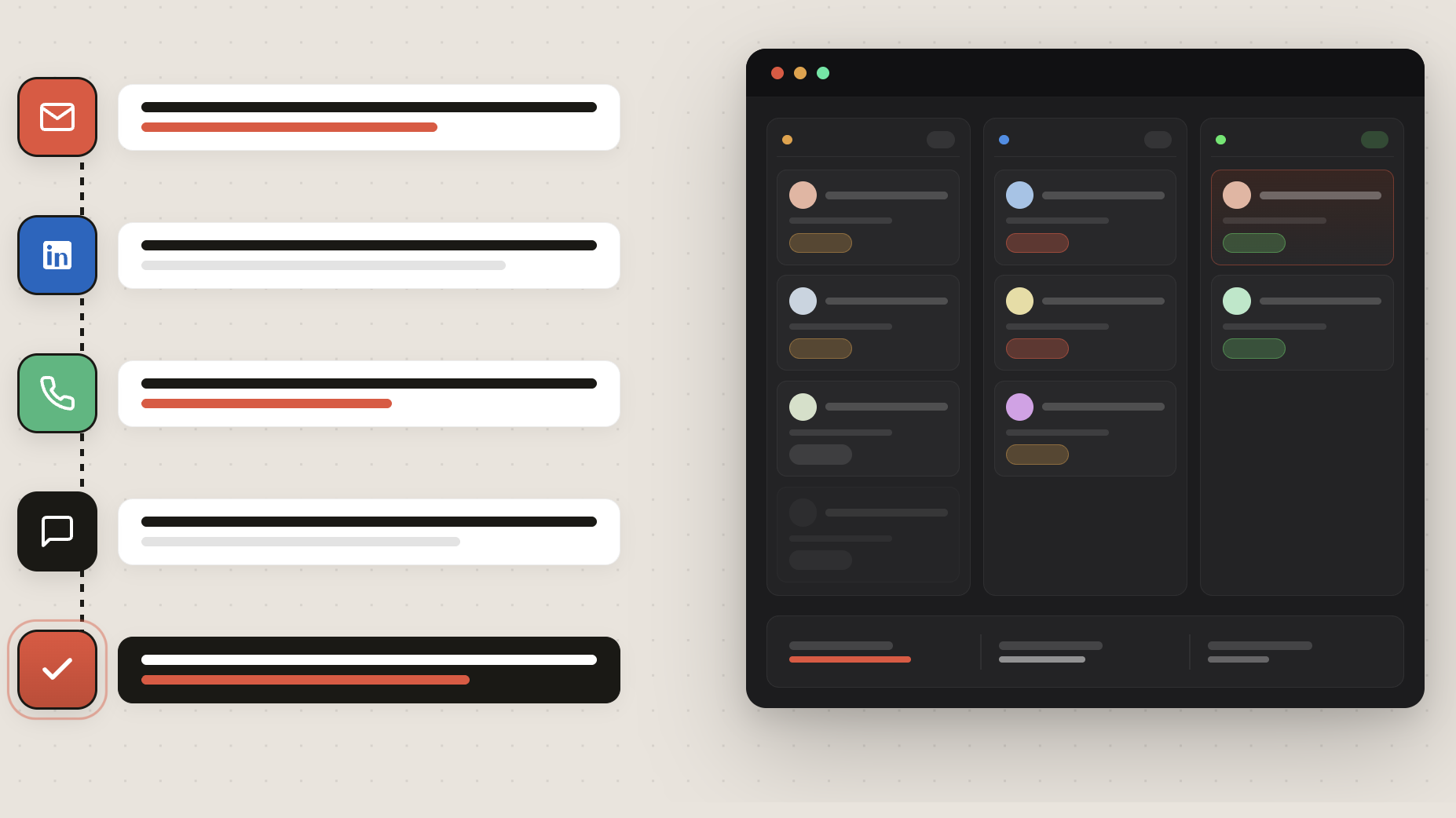
Follow up through email, phone calls, and LinkedIn messages according to a predefined outbound workflow. The sequence continues with a phone call, another LinkedIn message, and potentially an additional follow-up email.
Qualification and closing
Interested leads enter the sales pipeline while irrelevant prospects are filtered out.
Without a CRM to orchestrate these steps, your team wastes time managing spreadsheets, forgets follow-ups, and lacks visibility into the pipeline. This is where a CRM built for sales becomes extremely valuable.
The 3 types of CRM for sales teams
There are three major categories of CRM systems for customer relationship management:
1. Operational CRM
This is the practical, execution-focused CRM. It automates repetitive tasks such as email sending, follow-ups, and call management.
Centra falls into this category. It is ideal for sales teams that need to automate prospecting sequences at scale.
2. Analytical CRM
Data-oriented, this type analyzes prospect behavior, predicts buying intent, and segments leads according to scoring. It helps prioritize the hottest prospects in your pipeline.
Useful if you manage a very high volume of inbound leads.
3. Collaborative CRM
Designed to facilitate information sharing between teams (sales, marketing, support), it prevents departments from working in silos. Particularly useful in larger organizations where outbound involves multiple stakeholders on the same target account.
Centra is also a collaborative CRM.
Key features of a good CRM for sales teams
Cold email sequences and email campaigns
The ability to create automated cold email campaigns with conditional logic (if opened → follow-up X, if no reply → follow-up email Y) is fundamental. Email remains the highest ROI channel in B2B.
Each email should be customizable using dynamic variables (first name, company, job title).
Linkedin Sales Navigator integration
This tool is mostly used by managers and independent sales reps. Being able to easily import contacts from Sales Navigator is a major convenience. With Centra, all this data can be imported directly and sequences can be launched immediately afterward.
Call management
An integrated dialer allows reps to make calls directly from the sales platform, record conversations, and automatically schedule the next follow-up. Phone outreach remains an essential B2B prospecting channel.
Pipeline management
A Kanban-style view helps track the progress of every lead throughout the sales cycle.
Contact enrichment
Some CRMs include enrichment tools that automatically complete prospect profiles with emails and phone numbers. No data, no outbound.
All these features are included in Centra.
How to write a good prospecting email
Use a short, intriguing subject line
5 to 7 words maximum. Avoid overly “salesy” subject lines that trigger spam filters.
Personalize from the first line
Mention something specific about the company or prospect (a recent article, job opening, or event).
Keep your value proposition clear
In no more than two sentences, explain what you offer and why it matters to them right now.
Include a simple call to action
Ask one closed-ended question (“Would you be available for a 20-minute call this week?”), rather than sending a calendar link in the first email.
Always send follow-ups
70% of replies come after the second or third follow-up. Schedule your follow-up emails in your outbound CRM so you never forget.
Create multichannel sequences with your outbound workflow
Day 0: Personalized first-contact cold email
Day 3: LinkedIn profile visit + connection request
Day 5: Follow-up email if no response
Day 7: Phone call from the sales rep
Day 10: Personalized LinkedIn message
Day 14: Final “breakup” email
In your outbound CRM, set up this outbound workflow once. It then runs automatically for every new lead entering the sequence, while respecting GDPR requirements.
Which KPIs should you track to measure outbound performance?
Effective outbound sales rely on precise KPIs. Here are the essential metrics to track in your CRM:
Email open rate : target 40–60% for well-targeted B2B cold emails
Reply rate : target 5–15% depending on the industry and targeting quality
Lead conversion rate: ratio of qualified prospects generated by your cold email campaigns
Pipeline velocity: average sales cycle duration. A CRM helps accelerate it through automated follow-ups
Cost per SQL (Sales Qualified Lead): used to calculate the ROI of each outbound channel
Deliverability rate: crucial to ensure your emails do not land in spam folders
Final thoughts
A well-chosen CRM radically transforms your team’s performance. By centralizing touchpoints, automating prospecting campaigns, and providing complete visibility into your sales pipeline, it allows you to prospect at scale without sacrificing personalization.
IN SUMMARY
An outbound CRM centralizes your interactions, automates your multichannel sequences, and gives you the visibility needed to convert more prospects into customers. Precise targeting, complete sequences, and KPI analysis are the three pillars of predictable and scalable prospecting.