Apollo has everything to seduce at first glance: a massive database, an integrated email sequencer, and a clean interface. But for teams that prospect on Linkedin, that are looking for better data quality in Europe, or that want a less expensive alternative, there are interesting solutions.
IN BRIEF Apollo is a powerful sales intelligence tool, but its limitations - insufficient data in Europe, non-native Linkedin, and costs that rise quickly as volume increases - are pushing many teams to explore alternatives. This comparison presents the best alternatives to this tool to help you find the right one for your use case.
Why look for an alternative to Apollo.io?
Its database covers tens of millions of contacts, its email sequencer is well designed, and its free plan attracts many teams starting out in outbound.
Yet after a few months of use, certain frictions regularly appear:
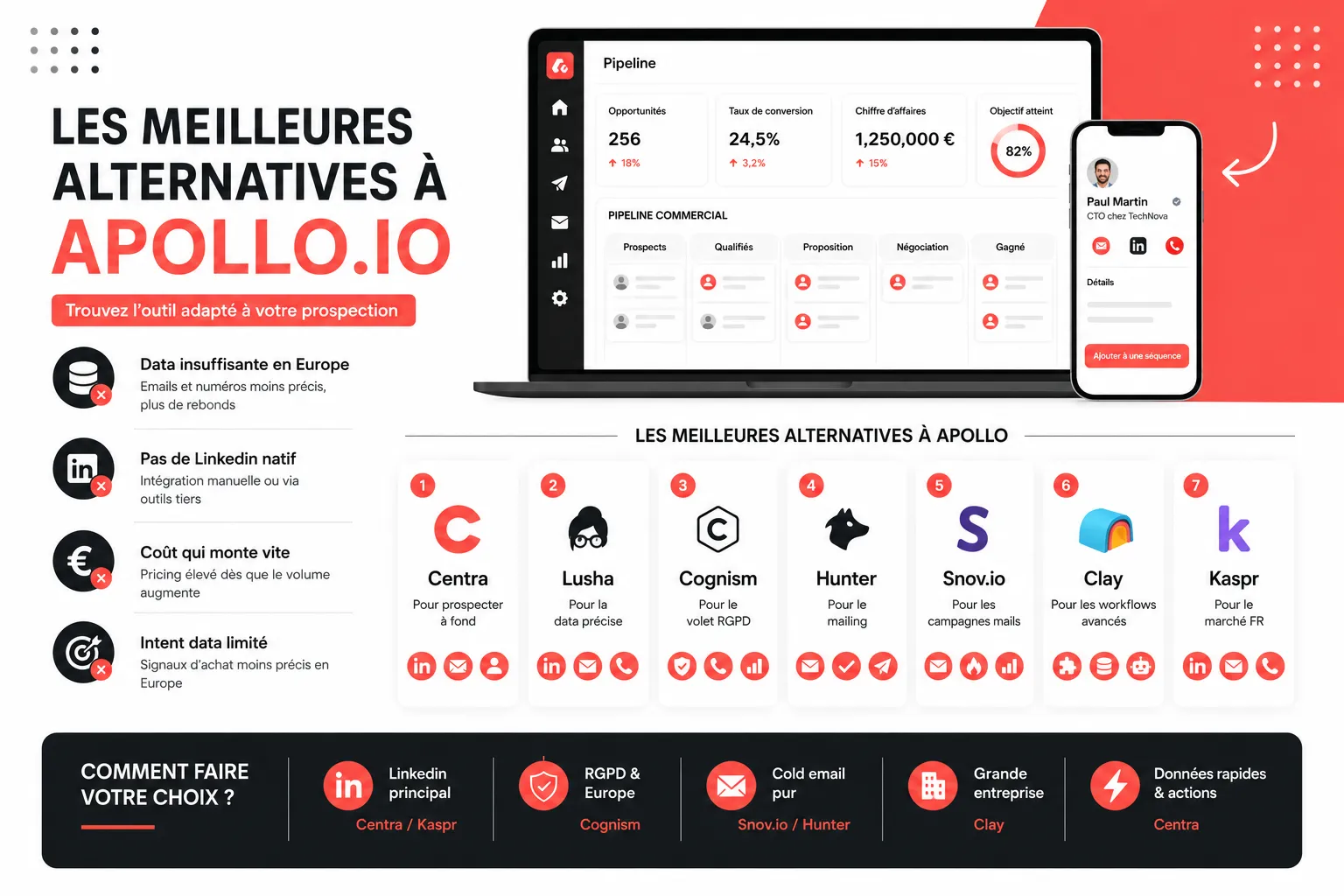
Insufficient data in Europe: the email addresses and phone numbers provided by Apollo.io are often less accurate in the French and European markets than in the US market. Email bounces accumulate and harm the deliverability of your campaigns.
No native Linkedin: Apollo does not integrate natively with Linkedin. You have to go through third-party tools or manage messaging manually, which creates friction in your workflow.
Cost that rises quickly: Apollo.io's free plan is limited, and the pricing quickly becomes prohibitive as soon as you need a serious volume of contacts, emails, or a complete email sequencer.
Limited intent data: buying signals remain less precise than specialized competitors like Cognism or ZoomInfo, especially for European companies.
The best Apollo alternatives for 2026
Centra - For heavy prospecting
Where Apollo.io forces you to juggle between a contact data tool and an external email sequencer, Centra groups everything into a single platform: Linkedin profile capture via Chrome extension, unified inbox (email + Linkedin), multi-channel outbound campaigns, and integrated contact enrichment.
You no longer need Apollo for email management, nor a separate Sales Navigator. You manage email and Linkedin within one consistent system.
It is aimed especially at SDRs, founders, and companies of 20-30 people.
Lusha - For precise data
Lusha is one of the best-known alternatives in the world.
Lusha is designed for a specific use case: finding verified email addresses and phone numbers in seconds, directly from a Linkedin profile.
Its Chrome extension integrates with Linkedin and Linkedin Sales Navigator to enrich contacts in one click. Lusha's data is good in the European market, both for emails and phone numbers. Lusha is appreciated by B2B SDRs who do volume.
Lusha is less complete than Apollo on email sequencing, but it compensates with data accuracy and ease of use.
Cognism - For the GDPR aspect
Its database is manually verified for the EMEA market and is guaranteed GDPR-compliant, unlike some American tools - Apollo included.
Cognism offers verified mobile phone numbers, but also tracks certain signals. It is a premium sales intelligence tool, particularly suited to large enterprises, notably depending on its cost.
One of the main issues is extraction: it is difficult to extract all the data from the tool in an unlimited way without paying a high price; you absolutely have to go through the platform.
Hunter - For emailing
Hunter.io allows you to find professional emails from a domain name. Its email verification tool is one of the best on the market for reducing bounces.
For a plan above the basic one, you have access to email campaign sending, which is practical if you focus on this channel.
It is complementary to a tool that gives you phone numbers, but Hunter's data is very good, hence its place in this ranking.
Snov.io - For email campaigns
Snov.io combines email search and email sequencing with warm-up in a single tool. It's a well-positioned alternative for teams that do cold email at large scale primarily.
The system is intuitive and has proven itself. It is a direct competitor to Hunter.
Clay - For advanced workflows
Clay is an alternative for technical teams who want to build custom data enrichment workflows. It aggregates multiple data sources (Apollo.io, Linkedin, Clearbit, Hunter...) and allows you to create highly targeted prospect lists using AI.
Clay is one of the most powerful tools on the market for advanced lead generation. This is both an advantage and a drawback: it will require time and technical skill to master, but it will be very useful if you want to fine-tune your outbound campaigns.
Important: it is one of the most expensive tools on the market.
Kaspr - For the French market
Kaspr is a French tool that retrieves email addresses and phone numbers directly from Linkedin profiles.
It is a good tool for salespeople who carefully select their contacts for prospecting, but the problem is that automation and list building are complicated. Empirically, however, it is a good solution for selecting contacts one by one.
How to choose among these tools?
The choice depends on your prospecting workflow:
Linkedin is your main channel: Centra or Kaspr. Centra is an excellent alternative for a multi-channel email + Linkedin approach.
You prospect in Europe and need to be careful about GDPR: Cognism is the best tool.
You do pure cold email: Snov.io or Hunter are good alternatives for email prospecting.
You are a large enterprise: Clay is the most complete, with a strong technical aspect.
You need fast data: Centra is the best alternative for getting data on numbers, emails, and enabling message sending on Linkedin.
Conclusion
Apollo remains a comprehensive solution for centralizing prospect research and cold email. But it is not necessarily the best choice for all teams, especially when data quality in Europe, Linkedin prospecting, or cost become priority criteria.
The right tool ultimately depends less on the number of features than on how you prospect.
Centra stands out for a multi-channel email + Linkedin approach, Lusha and Kaspr for data retrieval from Linkedin, Cognism for companies that prioritize data and compliance in Europe, while Hunter and Snov are particularly suited to cold email.
Before replacing Apollo, define your priority: data quality, Linkedin, cold email, automation, or budget. This criterion should guide your choice.
And if your goal is to build a truly effective prospecting machine, don't choose your tool solely on the size of its database: contact quality, targeting, and your ability to reach them at the right moment will often make a bigger difference than the number of available prospects.